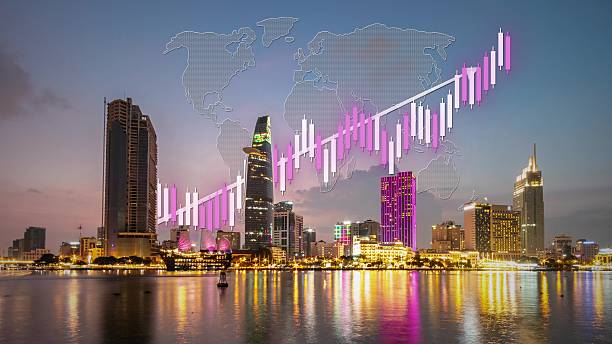
Exchange rates affect almost every business decision in Vietnam. Whether you are importing raw materials, paying overseas suppliers, investing in factories, or transferring profits abroad, currency movements can directly influence costs and profitability.
In 2026, investors are paying particular attention to the USD/VND and KRW/VND exchange rates as global interest rates, U.S. economic policy, Vietnam’s export performance, and Korea’s semiconductor cycle continue to shape the market.
• USD remains the key driver of VND movements
• Vietnam’s growth outlook supports medium-term currency stability
• KRW/VND is sensitive to Korea’s exports and semiconductor demand
• Businesses should manage FX exposure instead of assuming stable rates
Vietnam Economic Outlook Supports Long-Term Stability
Vietnam remains one of Asia’s stronger medium-term growth stories. World Bank and market reports continue to point to solid manufacturing, exports, infrastructure investment, and FDI inflows as key supports for the Vietnamese economy.
For the Vietnamese dong, this matters because strong growth and foreign investment can help reduce sharp currency instability. However, global USD strength can still create pressure on the VND in the short term.
Vietnam’s economic fundamentals remain supportive, but exchange rates will still depend heavily on the U.S. dollar cycle and global capital flows.
USD/VND Outlook for 2026
The U.S. dollar is still the most important currency for Vietnam’s exchange-rate outlook. If U.S. interest rates remain high or global risk sentiment weakens, the USD can strengthen and place depreciation pressure on the VND.
Several market forecasts expect USD/VND to remain near the mid-26,000 range during 2026, with moderate volatility rather than a severe currency shock scenario.
KRW/VND Outlook for 2026
For Korean companies operating in Vietnam, KRW/VND can matter even more than USD/VND. Korean won movements are closely linked to semiconductor exports, global technology demand, and investor sentiment toward Korea.
If semiconductor demand improves and Korean exports remain strong, KRW could recover against regional currencies. But if global risk sentiment weakens, KRW may remain volatile.
Practical FX Checklist for Businesses
✔ Monitor KRW/VND exposure if sourcing from Korea
✔ Maintain multi-currency cash planning
✔ Recalculate budgets when exchange rates move materially
✔ Consider timing of large equipment purchases
✔ Review export settlement currencies
What Should Investors Watch?
For 2026, the most important indicators are Federal Reserve rate decisions, Vietnam’s export and FDI growth, and Korea’s semiconductor export cycle. These three areas will likely determine whether USD/VND and KRW/VND remain stable or become more volatile.
1. Fed policy
Any delay in U.S. rate cuts can support the dollar and pressure Asian currencies.
2. Vietnam exports and FDI
Strong trade performance and steady investment inflows support VND stability.
3. Korea semiconductor cycle
KRW/VND can move sharply when semiconductor export sentiment changes.
Reference Links and Extracts
· Reuters — World Bank forecasts Vietnam 2026 economic growth at 6.8%
· Reuters — Moody's lifts Vietnam outlook to positive, affirms Ba2 rating
· The Investor — USD price likely VND26,400 in Q4 and VND26,300 in Q1 2026: UOB forecast
✔ World Bank projects Vietnam GDP growth of around 6.8% in 2026
✔ Moody’s upgraded Vietnam’s outlook to Positive
✔ UOB expects USD/VND to stay near the 26,100–26,400 range
✔ Strong exports and FDI remain key supports for VND stability
Final Note
Vietnam’s exchange-rate outlook for 2026 is not a simple story of VND weakness or strength. The better view is controlled volatility: Vietnam’s growth remains supportive, but global USD cycles and regional currency movements will continue to matter.
For companies and investors, the safest approach is to plan budgets with exchange-rate scenarios, monitor USD/VND and KRW/VND regularly, and avoid leaving large currency exposure unmanaged.